Open ChatGPT. Type "what's the best non-custodial wallet for Solana." Read the answer. No ads, no ten blue links. One synthesized response with three or four citations. The projects named will get the wallets connected. The projects not named are invisible. This is the playbook for getting cited. How AI engines decide. The Web3 Trust Hub you need to be on. The LLM Sitemap methodology we developed. From my experience, LLM-referred traffic converts ~4.4× higher than organic — the user arrives with the AI's pre-conferred trust.

TL;DR

  • AI Overviews show on 25-50% of Google searches. Every educational crypto query we tested triggered one (Ahrefs, April 2026).
  • Citation = Authority × Content × Technical. Any factor at zero kills the output. Most teams optimize content with zero authority and wonder why nothing happens.
  • Map your Trust Hub first. For Web3 it's CoinDesk, The Block, Decrypt, Wikipedia, Reddit, plus 4-6 category-specific platforms. Skew presence work 70/30 third-party to self-published.
  • Bullets under 15 words extract verbatim. Over 15, your specific claim becomes generic filler.
  • LLM Sitemaps + canonical definition. Identical positioning across every page and external profile, structured as a clustered HTML hierarchy AI can parse.
  • Pick topics where AI can't compete. Niche specificity wins. Generic keywords are now where AI generates a better answer than your page.
  • Measure citation share, not rankings. Run your top 20 queries through ChatGPT, Perplexity, AI Overviews monthly.
10/10crypto educational queries triggered AI Overviews (Ahrefs)
4.4×LLM traffic conversion vs organic
~21%of Google AI Overviews cite Reddit
7-8%of ChatGPT citations are Wikipedia
How an LLM constructs an answer
Optimize stages 2 and 3. Stage 4 follows.
01 02 03 04 User query Retrieval Synthesis Cited answer ↑ BE RETRIEVABLE ↑ RANK HIGHEST distribution work on-page work

One mental model. Citation isn't additive. It's multiplicative.

The citation equation
Any factor at zero kills the output. Most teams optimize content first.
Authority × Content × Technical = Citation 0 × 10 × 10 = 0
What this guide is built on. Nine years of running campaigns through every search shift, the LLM Sitemap methodology developed across 50+ B2B SaaS and crypto client engagements, and original research on AI search behavior. The tactics here are the ones that survived contact with real client work.

Why GEO Matters More for Web3 Than Other Industries

  • Adopters. Same audience that left banks for DeFi, Reddit for Farcaster, Excel for Dune. AI search adoption runs months ahead of mainstream.
  • Question shape. "How does X work," "is Y safe," "best Z for use case." Exactly what AI handles best.
  • Trust threshold. Users research before depositing into smart contracts. AI now mediates that research. Not cited = a YouTube video defines your reputation.

How AI Engines Decide What to Cite

Each engine pulls from a different mix of sources.

Where each AI engine pulls from
Same query, different mechanics.
CHATGPT Wikipedia 7-8% Reddit ~5-6% Tier-1 media ~4-5% Brand sites ~3-4% Long-tail content ~2-3% PERPLEXITY News + tier-1 ~12-15% Reddit ~10-12% Niche industry ~7-9% YouTube ~5-7% Wikipedia ~4-5% GOOGLE AI OVERVIEWS Reddit ~21% YouTube ~18-19% High-DR domains ~12-14% News + media ~8-10% Quora + forums ~5-7%

The four retrieval mechanics behind every AI answer

Four ways your project gets into an AI answer. Optimization opportunities sit between them.

MechanismHow it worksHow to influence itTime to land
Training data recallLLM "remembers" you from training corpusMentions across high-authority pages over time6-18 months
Live web retrieval (RAG)LLM searches the web during the queryRank well in SEO; Bing index mattersDays to weeks
Knowledge graph entriesWikipedia, Wikidata, Crunchbase referenced directlyEarn entries; maintain accurate public recordsMonths
Domain memorizationFor named brands, the LLM has the brand "memorized"Consistent mentions over long periods, consistent framing12+ months

Optimize for live retrieval (days) and training-data recall (12+ months) in parallel.

The Five Channels That Feed AI Citations

Every niche has a Trust Hub — the cluster of domains LLMs reference for that niche. For B2B SaaS it's G2, PeerSpot, Wikipedia. For Web3 it's a different set. Map yours before spending on anything.

The Web3 Trust Hub
Tier 1 mandatory. Tier 2 high-value. Tier 3 specialized.
TIER 1 Wikipedia CoinDesk The Block Reddit TIER 2 Decrypt DefiLlama Messari YouTube TIER 3 Cointelegraph CoinGecko GitHub Stack Exchange

Skew presence work 70/30: roughly 70% of brand mentions from independent third parties, 30% self-published. The other way reads as manufactured.

1. Wikipedia

Highest-leverage AI citation move. Top source in ChatGPT, major source in every other engine, feeds Google's Knowledge Graph. One legitimate page is worth ten tier-1 PR placements. Strict notability rules — build legitimate independent sources first, then have an experienced editor draft a neutral, fully-cited page.

2. Reddit

~21% of Google AI Overview citations include Reddit. Perplexity surfaces it heavily. ChatGPT's web tool pulls it constantly. What works:

  • 90+ days of genuine subreddit presence before promotion. Smaller category subs (r/defi, r/ethereum, r/Solana) over r/CryptoCurrency.
  • Answer specific questions usefully. Complete reply, mention project once in context.
  • Original research posts. On-chain analysis with TL;DR gets archived and AI-cited.

3. Tier-1 crypto media

Domain authority is the single strongest predictor of AI citation (SHAP 0.63, SE Ranking 2025). One CoinDesk, The Block, or Decrypt editorial feeds training data and live retrieval simultaneously, often for years. Earn it through expert outreach. Wire-service press releases produce zero lift.

4. YouTube

~18-19% of Google AI Overview citations include YouTube. Build 3-5 mid-tier creator relationships and your own founder-on-camera channel. Production value optional, accurate captions mandatory — AI extracts from transcripts.

5. Your own domain

Cited mostly for branded queries unless authority is serious. The work that earns non-branded citation:

  • Original research and data. Public Dune dashboards, on-chain analyses with specific numbers.
  • Comparison pages. "X vs Y" with structured tables.
  • Long-form pillar pages. 3,000+ words on topics where you have genuine expertise.
  • FAQ blocks with schema markup.
  • An LLM Sitemap. Detailed below.

Two silent blockers most teams miss

OAI-SearchBot. Separate crawler from GPTBot — handles ChatGPT's live browsing. Older robots.txt templates miss it. Allow GPTBot, OAI-SearchBot, ClaudeBot, and PerplexityBot explicitly.

Cloudflare Bot Fight Mode. Blocks AI crawlers at the network layer regardless of robots.txt. We see this in roughly one in three audits.

The GEO Content Stack

Each layer enables the next. Most projects skip the foundation, start at the top, and nothing compounds.

The five-layer GEO stack
Build bottom-up. Each layer depends on the one below.
Citation share Distribution Content + structure Machine-readability Technical foundation

Pick Topics Where AI Can't Compete

Most teams pick topics by search volume. That's how you write "what is crypto" content where ChatGPT generates a better answer than your page. Write where AI can't follow.

Where AI can't follow you
More specific = harder for AI to compete. Move right.
AI WINS AI NEEDS YOU "what is crypto?" "best crypto wallet" "best wallet for Solana DeFi" "non-custodial wallet for SOL DeFi traders" "multi-sig for DAO treasury on Solana"

LLM Sitemaps: The Methodology We Developed

An XML sitemap tells Googlebot what URLs exist. An LLM Sitemap tells AI crawlers what your project does, how content is organized, what concepts relate, and when to recommend you. A clustered HTML page (not XML) with pillar-cluster hierarchy, embedded FAQs, comparison tables, and explicit semantic relationships. Developed across 50+ B2B SaaS and crypto client engagements.

The most important element: a canonical definition repeated identically across every page and external profile. The formula:

The canonical definition formula

  • [Project] is a [specific category] for [target user] that [primary function]. Unlike [well-known alternative], it [differentiator with measurable claim].

"Specific category" means one thing. Not "comprehensive," not "all-in-one." Identical phrasing across homepage, About, LinkedIn, Crunchbase, PR boilerplate. When the model sees three different descriptions, it hedges and recommends the competitor it sees described consistently.

LLM Sitemap structure
Pillar → cluster → semantic links. Machine-readable hierarchy.
Project Staking DeFi Wallets validators slashing LSTs lending DEXs yield hardware non-cust. multi-sig PILLAR · CLUSTER · - - - SEMANTIC CROSS-LINK

What goes inside an LLM Sitemap

  1. Pillar pages, 3-5. One canonical 3,000+ word page per top-level topic.
  2. Cluster pages, 3-8 per pillar. Sub-topics linking back to pillar and laterally.
  3. FAQ blocks, 6-10 per cluster. First-person Q&A with FAQ schema.
  4. Comparison tables, 1-2 per cluster. Structured tables with named columns.
  5. Explicit semantic cross-links. Anchor text that names the relationship between concepts.
  6. An HTML index page. The actual "LLM Sitemap." Submit in robots.txt, link from footer.

Projects shipping a real LLM Sitemap see citation share grow 2-3× faster. Structure is the optimization.

Submit your LLM Sitemap explicitly

Add to robots.txt: Sitemap: https://yoursite.com/llm-sitemap. Link from your footer. AI crawlers are starting to look for these signals.

The all-in-one trap

Products positioned as "all-in-one" or "the operating system for X" give the model no clear answer to "when should I recommend this?" Own one specific category first. Vague positioning = invisible citations.

On-Page Optimization for AI Extraction

Six rules. Same project, same fact — completely different outcomes inside an AI answer. The pattern isn't subtle.

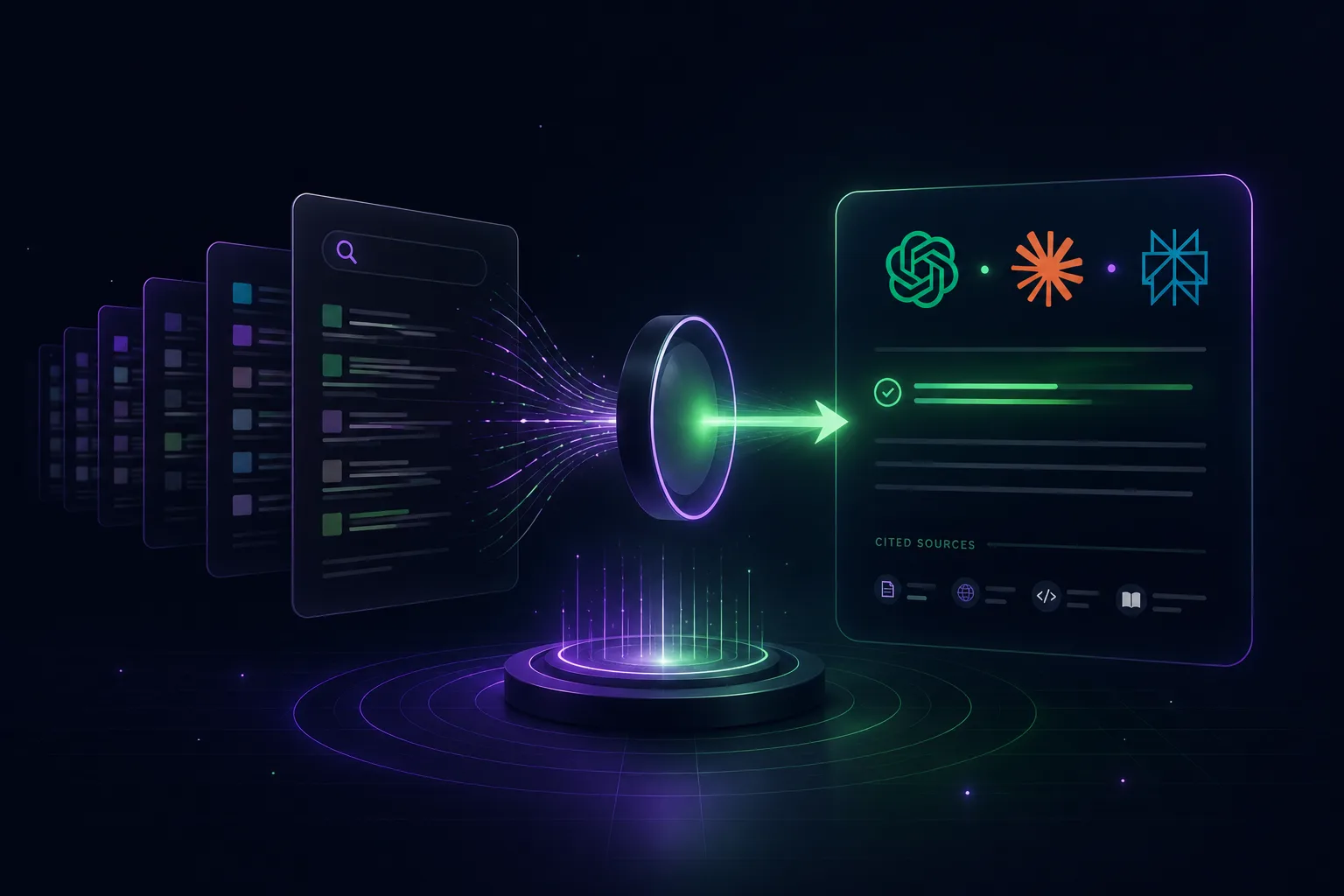
What AI extracts. What AI ignores.
Specific over vague. Named over anonymous.
01 Answer first "In this article we'll explore..." "Solana DeFi avg gas: 0.0003 SOL" 02 Bullets < 15 words "Significantly reduces gas costs..." "Reduces gas costs by 47%" 03 First-person FAQs "What is liquid staking?" "I run DeFi — best LST?" 04 Numbers "Greatly improves throughput" "65K TPS · 400ms blocks" 05 Named experts "By [Project] Team" "By Yuval Halevi" 06 Recency (no date anywhere) "Updated April 2026"

Schema Markup That Matters Most

Use Schema.org JSON-LD. Test before shipping. Broken markup gets your page deprioritized.

Schema typeWhere to use itWhat it does for AI citation
FAQPageBottom of every meaningful pageMost extracted format. AI engines pull Q&A directly into answers.
ArticleEvery blog post and guideAuthor, publish date, topic — signals authority and freshness.
OrganizationHomepage, about pageFeeds Knowledge Graph entries. Critical for branded query citations.
PersonAuthor byline pages, team pagesEstablishes named-author authority. Links to LinkedIn, prior work.
BreadcrumbListEvery non-homepage pageHelps AI engines understand your site's hierarchy.

AI Overviews Are Now the Default

Fresh Ahrefs check (US, April 2026) on common educational and decision crypto queries:

QueryVolume / moKDAI Overview
what is crypto30,00081✓ shown in SERP
what is staking crypto7,90073✓ shown in SERP
how does cryptocurrency work6,70083✓ shown in SERP
what is crypto mining6,70075✓ shown in SERP
should i buy bitcoin now3,50042✓ shown in SERP
best way to buy crypto2,50083✓ shown in SERP
how does crypto mining work1,50071✓ shown in SERP
how does blockchain work80088✓ shown in SERP

Eight of eight crypto educational queries trigger AI Overviews. Same pattern across all 25 we sampled. Source: Ahrefs Keywords Explorer, US, April 2026. Every educational keyword you ranked for in 2022 now has an AI Overview competing above the blue links. Half your potential clicks never happen. Not in the cited sources = invisible.

The Brand Presence Compound Effect

Brand mentions inside answers compound even when nobody clicks. Someone asks ChatGPT "best L2 for DeFi" — your project lands in their head whether they visit your site or not. Next time they're picking an L2, you're a known option. Recognition jumps. Direct search volume for the brand grows. None traces back to a specific channel.

Brand presence compounds
Three projects, identical product work, different GEO investment.
CITATION SHARE % 25% 20% 15% 10% 5% 0% Q1 Q2 Q3 Q4 Q5 Q6 A · full GEO B · moderate C · none

Project A's curve is the pattern. Months 1-9 feel like nothing. Then the work compounds. Q6 hits 22% citation share — work done quarters ago producing citations the team never directly chased.

Measuring AI Visibility: What Actually Counts

GA only shows referrals when users click. It misses every mention inside an answer they didn't click. You need manual audits.

The six dimensions of AI visibility

AI visibility across six dimensions
Before vs. after a 12-month GEO program.
ChatGPT Perplexity Google AIO Wikipedia Reddit YouTube BEFORE AFTER

The monthly AI visibility audit (1-2 hours)

  1. Pick 20 category queries — mix of educational, comparative, decision. Same 20 every month so you can track changes.
  2. Run each through 4 engines — ChatGPT (web tool), Perplexity, Gemini, Google AI Overviews. Log who gets cited, position in citation list, sentiment.
  3. Compare against 3-5 named competitors — track whether you're gaining or losing share against specific rivals.

5 baseline diagnostic prompts to run today

Run these in ChatGPT, Claude, and Perplexity before changing anything. Gaps between platforms tell you where to invest first.

1. "What do you know about [Project]? Category? Primary use?"
2. "Best [your category] tools for [target user]? List top 5."
3. "Compare [Project] vs [Top Competitor]. Who is each best suited for?"
4. "What is [your category]? Leading solutions and what differentiates them?"
5. "On a scale of 1-10, how well-known is [Project] in [your category]?"

Tools worth knowing

ToolWhat it doesApprox pricing
ProfoundMost-established AI visibility tracker. Citation rate, sentiment, share of voice across major engines.$200-$2K/mo
AthenaHQReal-time AI visibility tracking with competitor benchmarks.$150-$1K/mo
Goodie AI / QuirkAI search analytics, custom query monitoring, programmatic API access.$100-$1.5K/mo
Ahrefs Brand RadarBrand mention tracking across AI engines, bundled with Ahrefs.included
Manual + spreadsheetFree. Slower. Reading every answer monthly teaches you more than any dashboard.$0 + 2-4 hrs/mo

7 GEO Mistakes That Keep Web3 Projects Invisible

MistakeWhy It HurtsThe Fix
Treating GEO as separate from SEOSkips foundation, never compoundsSame content, structured for both. 70/30 SEO/GEO budget split.
Anonymous "team"-bylined contentAI engines weight named authorityReal authors with LinkedIn, prior work, named expertise.
Buying press release distributionLow-authority destinations = zero AI liftEarn tier-1 editorial mentions through expert outreach.
Skipping WikipediaHighest-leverage single citation sourceEarn legitimate sources, then draft a neutral page.
Spamming RedditDetection sophisticated, gets you bannedGenuine 90+ day community presence before any promotion.
No FAQ schemaMisses highest-extraction content formatAdd FAQPage JSON-LD on every meaningful page.
Not measuring anythingCan't optimize what you don't trackMonthly 20-query audit, minimum.

Expert tip · stop over-optimizing

People run AI audits constantly now. Ask Claude to audit your site and it'll always find something. The question is whether fixing it actually moves citations. Mostly it doesn't.

Real standard: clean site, fast load, brand voice clear, structured content, AI crawlers can access, canonical definition consistent everywhere, LLM Sitemap shipped. Companies that get cited fastest close the fundamentals once and spend their energy on Trust Hub presence — not endlessly re-auditing schema.

Final Thoughts

AI search optimization for Web3 in 2026 isn't a separate discipline. It's the next layer of SEO. Teams that win build the foundation properly — technical SEO, real authority, named expertise — then layer GEO-specific moves on top. Six months in the curve bends. Twelve months in you're cited as the answer in your category.

If you're working on a Web3 project that needs AI search optimization, get in touch. Or our Web3 SEO guide for the foundation GEO sits on top of.

About the author

Yuval Halevi
WRITTEN BY
Yuval Halevi
Founder, GuerrillaBuzz · Web3 SEO & AI search since 2017

Yuval is the Co-Founder of GuerrillaBuzz. He's been running Web3 SEO and content programs since 2017 across every cycle, and developed the LLM Sitemap methodology now used across 50+ B2B SaaS and crypto client engagements at GuerrillaBuzz and Growtika.

Last updated: May 2026 · refreshed continuously · flag outdated facts via contact