TL;DR

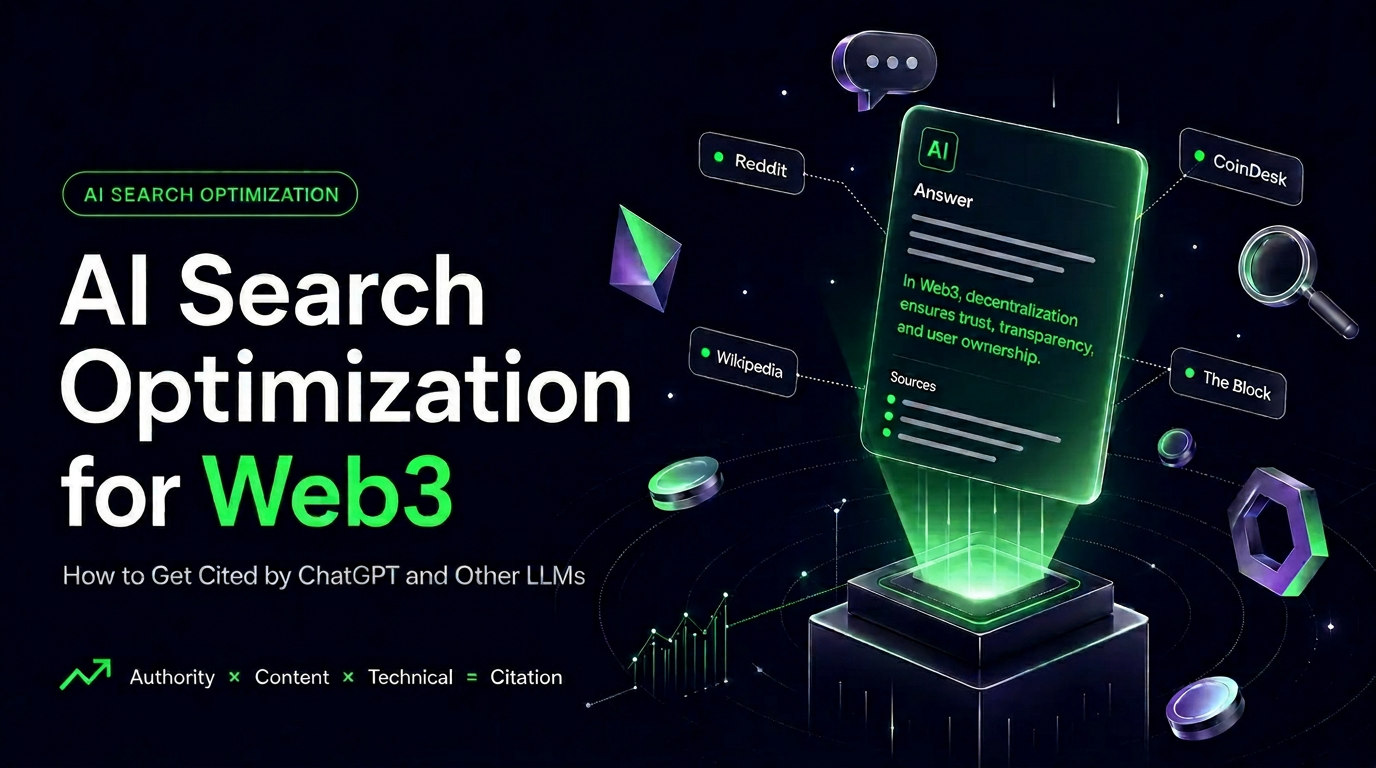
  • Crypto AI citation is centralized. About 100 domains absorb most recommendation queries.
  • You won't crash that club next quarter. You build authority in your lane instead.
  • The principle: build for humans, LLMs follow. The signals are the same.
  • The stack, bottom to top: foundations · content · transparency · outside validation · real audience.
  • The strategy: long-tail blogs and long-tail money pages. Win your niche first.

Crypto AI Search Is A Centralized Game

Type "best crypto exchange" into ChatGPT fifty times. Same three to five names. "Best DEX." Same three. "Best L2." Same five. The recommendation pool is small and the same domains recycle.

The crypto AI citation field
Where AI models pull from when answering crypto recommendation queries.
~10 dominant ~100 recurring 10,000+ the rest of the crypto web

Your job isn't to displace the dominant cluster. It's to earn citations for the queries that matter to your actual buyers: specific solutions, use cases, verticals. That path runs through real authority.

Build For Humans. LLMs Follow.

The signals AI models use to evaluate authority are almost identical to the signals a smart human uses. There isn't a separate "AI marketing" game running in parallel. There's just authority, and AI is measuring it.

Human authority signals vs LLM authority signals
The overlap is the article. Build for the human read; the AI read comes with it.
Human read LLM read Same signals. Same authority. memory of past visits embedding freshness

Build a project a smart human respects, document it well, and the LLM signals fall into place. Build a project optimized for AI tricks while ignoring the human read, neither audience cites you.

The Authority Stack

Five layers. Each one builds on the previous. Skip a layer and the stack wobbles. Most teams jump to the top and wonder why nothing sticks.

The Authority Stack
Built bottom up. Each step depends on the steps below it. There are no shortcuts.
1 Foundations crawlable site, schema, brand 2 Your story useful content, not self-promo 3 Transparency wins, losses, progress, in public 4 Outside validation relevant others (incl. non-crypto) 5 Real audience genuine engagement, not bought result build order
LayerWhat it covers
1. FoundationsFast site, semantic HTML, schema on every page, LLM-readable copy (text, not animations), brand recognition. The boring layer most crypto teams skip.
2. Your storyEducational content in your niche. Original technical posts from named experts. Consistent cadence over volume. Useful first, brand second.
3. TransparencyRoutine progress updates. Decision postmortems. Share losses, not just wins. Public record of how you actually operate.
4. Outside validationNiche industry trade press in your vertical. Cross-vertical partnerships (compute, fintech, asset management). Tier-1 mainstream when accessible.
5. Real audienceThe output. Genuine engagement, real power users vouching for you, real community. AI models cross-reference; bought metrics don't survive this.
The shortcut that doesn't exist: you cannot buy Layer 5. Cross-referencing between sources, models, and timestamps catches manufactured signals fast. Build the real version.

The Long-Tail Strategy

Authority gets you eligible. Strategy gets you cited for queries that matter. For most crypto projects that strategy is long-tail, in both blog content and money pages (solutions, industries, use cases).

The head terms are owned. "Best crypto wallet": volume 11,000, difficulty 94. "Best crypto exchange": 8,300, difficulty 94. You're not winning there. The opportunity is below the head terms, where AI models still need answers and the incumbents haven't camped:

Where the realistic opportunity sits
Each dot is a real crypto query. Position by volume and difficulty. Win the green zone first.
DON'T COMPETE HERE MONEY PAGES + COMPARISONS START HERE · BLOG + EXPERT CONTENT 0 100 DIFFICULTY 11K 2K 10 VOLUME best crypto wallet coinbase vs binance mev protection perpetuals dex

"Account abstraction wallet": 150 monthly searches, difficulty 34. "MEV protection": 150 searches, difficulty 43. "Real-world assets tokenization": 150 searches, difficulty 60. Win a dozen of these and you've built real category authority before anyone notices.

Money pages matter as much as blogs. A solution page for "perpetuals DEX with cross-margin" beats a homepage for any LLM matching a specific intent. Build one money page per meaningful slice: solutions, industries, use cases, integrations.

Time horizon: years. Compound the long-tail wins. By the time you have 50 niche pages cited in their categories, your authority lets you go after harder targets. That's how everyone currently in the citation pool got there.

What Doesn't Work

FAILED 01
Paid press releases on weak domains

Wire-distribution to low-authority crypto sites. Backlinks land, citations don't.

FAILED 02
KOL mention campaigns

Paid Twitter mentions. No training data entry, not retrieved during browsing.

FAILED 03
AI-generated content at scale

Spinning 100 long-tail posts. LLMs detect and down-weight the domain.

FAILED 04
"Guaranteed ChatGPT placement"

No mechanism exists. Anyone selling this is selling a black box.

FAILED 05
Stuffing llms.txt with marketing copy

Ignored. Use it for navigation, not positioning.

FAILED 06
Bought audience metrics

Cross-referenced and detected. Damages the project rather than helping.

How To Test What AI Says About Your Project

Baseline first. Change one variable at a time. Re-test in 4-week intervals. Single queries are noisy; patterns across 5-10 runs are stable.

Test typeWhat it revealsHow to run
Direct identity
"What is [project]?"
Stored knowledge of your brand and what shaped itFresh chat, browsing off, 3 runs. Then browsing on. Compare.
Niche recommendation
"Best [specific use case]?"
Whether you surface for queries actually relevant to your buyers5-10 runs. Use the long-tail queries you're targeting.
Competitor comparison
"Compare [you] and [competitor]"
What the model thinks differentiates youBrowsing on and off separately. Gap shows stored vs. live.
Live retrieval
"Recent news about [project]?"
Which domains the model treats as authoritative nowBrowsing on. Each cited URL is a real signal.
Adversarial
"Criticisms of [project]?"
What negative info is in the model. Address editorially.Document, trace each claim to source.

Run the same tests across ChatGPT, Claude, Perplexity, and Gemini. Cited sources differ. Test where your audience actually asks.

Your GEO Action Checklist

Five phases, seventeen items. The 90-day execution path for everything above. Bookmark this page; your progress saves automatically.

CRYPTO GEO · 90-DAY PLAYBOOK
Your 90-day action checklist
Bookmark this page and work through it in order. Each phase depends on the one below.
1
Foundations
This week
2
Your story
This month
3
Transparency
Start now, ongoing
4
Outside validation
This quarter
5
Real audience and verification
Ongoing, monthly

The Bigger Picture

The crypto teams that earn AI recommendations in 2026 aren't running a separate AI playbook. They're building real authority for real humans, and authority is what the models can measure. Foundations. Useful content. Public transparency. Cross-vertical coverage. A community that actually shows up. The work compounds. The shortcuts don't exist.

The citation pool is centralized. You build authority in your lane until your project becomes the obvious cite for queries your buyers actually ask. Build for the human read. The LLMs follow.

Methodology and disclaimers. Methodology and disclaimers. Practitioner framework from work with 30+ crypto projects 2023-2026 and parallel research at our sister agency Growtika across B2B SaaS. We do not have access to OpenAI, Anthropic, Google, or Perplexity training or retrieval internals. Framework reverse-engineered from observed citation behavior. Ahrefs keyword data pulled May 2, 2026 (US): "best crypto exchange" 8,300 vol / difficulty 94; "best crypto wallet" 11,000 / 94; "account abstraction wallet" 150 / 34; "MEV protection" 150 / 43; "real world assets tokenization" 150 / 60. Citation pool size (~100 dominant domains) is directional, based on observed citation overlap across prompts. Visualizations are conceptual; dot sizes and zones reflect observed patterns, not measured percentages. AI systems evolve quickly. Not investment, legal, or regulatory advice.

If you're working on getting your crypto project recommended by ChatGPT, Claude, Perplexity, or Gemini, we'd love to hear what you're building. GuerrillaBuzz has been running PR, SEO, and now AI search work for crypto teams since 2017. We bundle the foundations into our AI search optimization service, layered on top of blockchain SEO, Web3 PR, and Reddit marketing. Get in touch for a free 30-minute audit, or browse the blog for more teardowns and playbooks like why ChatGPT doesn't recommend most tokens and the Cointelegraph traffic collapse.

About the author

Yuval Halevi
WRITTEN BY
Yuval Halevi
Co-founder, GuerrillaBuzz · Crypto PR, SEO and AI search since 2017

Yuval has spent nine years building authority for crypto projects across PR, SEO, and now AI search. He also runs the GEO research practice at GuerrillaBuzz's sister B2B SaaS agency Growtika, where much of the framework in this article was reverse-engineered from real client citation data across ChatGPT, Claude, Perplexity and Gemini.

Last updated: May 2026